
As we conclude our first season of the Resistant Communiqués Podcast, the Resistant Communiqués Collective wants to thank you for your listenership and learning with us.
Along with you, we have learned a great deal from a set of incredible guests. And as a Collective, behind the scenes, we also learned a lot about making a podcast, from episode concept development, production, post-production, and communications, to every other piece that goes into producing a People’s and Resistance History podcast. We learned a lot as a collective this season, and we appreciate having our audience as participants in this process.
We are so fortunate to have received incredible feedback individually from many of our co-learners and listeners. If you have enjoyed the podcast this season, one of the easiest ways to support our work is to rate the podcast on whatever platform you use to listen and to rate the individual episodes you loved. Like the Substack post and repost, if so desired. Leaving a rating or review signals that our content is worth recommending and helps new listeners find us. Ratings, reviews, downloads, and subscriptions all play a role in how platforms amplify podcasts, so every small action makes a real difference in expanding our reach and sustaining this work.
If you are interested in supporting this grassroots project more directly, we invite you to join our community of paid subscribers. We now have a full season of content, so you can hear the quality, care, and depth we bring to each episode. A contribution of just $5 a month (or an annual subscription of $80) goes directly towards improving the podcast, supporting future episodes, and helping us keep this work accessible and independent.
Now, onto our Special End-of-Season December episode.
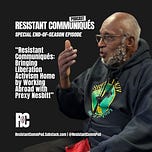
The Resistant Communiqués Collective is incredibly honored to present our first special end-of-season episode, “Special End-of-Season Episode! Resistant Communiqués: Bringing Liberation Activism Home By Working Abroad with Prexy Nesbitt” (Season I, Episode VII), featuring Prexy Nesbitt, an activist and teacher who has spent his life involved in Transnational Liberation struggles.
December is a vitally important month in the history of people of African descent. In the United States, Rosa Parks was arrested for refusing to yield her bus seat on December 1, 1955; Martin Luther King, Jr. inaugurated the Poor People’s Campaign on December 4, 1967; and the 13th Amendment that ended chattel slavery was ratified on December 6, 1865. In Africa, the Ivory Coast, Tanzania, and Kenya all received their independence in December, and December 16 is South Africa’s National Day of Reconciliation. This significance runs right up to the present: the Jasmine Revolution began in Tunisia on December 17, 2010, when Tunisian street vendor, Mohamed Bouazizi, self-immolated outside a government building, in an act of despair in protest against widespread unemployment and poverty, government corruption, and state repression. The Jasmine Revolution in Tunisia was the first, sparking a series of revolutions culminating in the Arab Spring against authoritarian regimes across the region.
Today, we are witnessing a global reactionary movement in support of white supremacy, from North America to Europe. Donald Trump’s naked, crude racism has come to dominate both domestic and foreign policy, with Trump suggesting that Somalis in this country should be denaturalized and deported, and on the other hand, engaging in violence against people of color. On Christmas Day, the U.S. military carried out strikes in Nigeria, allegedly to support Christians being attacked by Nigerian Muslims.
Our guest this month is Prexy Nesbitt, a longtime Chicago activist who spent decades working to support the anti-apartheid movement in South Africa and the fight for freedom in Namibia, Mozambique, Angola, Guinea-Bissau, and Zimbabwe. Nesbitt’s history and experience illustrate that the struggles for liberation and dignity cannot be separated, and that, moreover, we strengthen our own movement by supporting others.
Prexy Nesbitt grew up on Chicago’s West Side. After graduating from Francis Parker School, he went to Antioch College in Ohio and earned his degree in 1967. He then continued his studies at the University of Dar es Salaam in Tanzania, Northwestern University, and Columbia University.
Nesbitt was highly active in labor and equality movements. In 1976, he became national coordinator and field organizer for the Bank Withdrawal Campaign of the American Committee on Africa. In 1978, he was named director of the Africa Project at the Institute of Policy Studies in Washington, D.C. The following year, he was appointed program director and secretary for research at the World Council of Churches in Geneva, Switzerland. In 1986, Mayor Harold Washington appointed him a special assistant. The following year, Mozambique’s government chose him as a consultant to represent its interests in the United States, Canada, and Europe, a role he held until 1992.
In 1993, he was appointed senior program officer for the Program on Peace and International Cooperation at the MacArthur Foundation, where he remained until 1996, when he was named dean of community engagement and diversity. During this time, Nesbitt also taught African and American history at Francis W. Parker School and African history at Columbia College. He continued to teach until 2023.
Here is our interview with Prexy Nesbitt…
Listen, share, and study with us using the multimedia syllabus below.
Luta,
Resistant Communiqués Collective
Learn more about Resistant Communiqués on the About page (here).
Accessibility: The transcript for this episode is available.
Want more Resistant Communiqués?
Follow us (@ResistantCommPod) across all social media platforms: Instagram | TikTok | Mastodon | Bluesky | Threads | Facebook

Learn More about our Creative Commons Licensing in Terms of Service.
Multimedia Syllabus
Note: This is not an exhaustive bibliography; it serves as a starting point for further research.
African & U.S. Perspectives: Race, Racism & Capitalism
Aiken, J. (2022, August 9). What the Panthers Meant By Self-Defense: Race, Violence, and Gun Control. Duke Center for Firearms Law. https://firearmslaw.duke.edu/2022/08/what-the-panthers-meant-by-self-defense-race-violence-and-gun-control
Books & Books (Director). (2020, August 6). Charlie Cobb This Nonviolent Stuff’ll Get You Killed, How Guns Made the Civil Rights Movement Possible [Video]. YouTube.
Illinois Holocaust Museum & Education Center (Director). (2021, March 12). Degrees of Separation: Working Toward Racial Justice in the U.S. and South Africa – In Conversation with Rozell “Prexy” Nesbitt and Marissa Moorman [Video]. Youtube.
Review of African Political Economy (ROAPE). (2018, September 13). Black Consciousness and Anti-Capitalism: The Legacy of Steve Biko. Review of African Political Economy (ROAPE) Publications. https://roape.net/2018/09/13/black-consciousness-and-anti-capitalism-the-legacy-of-steve-biko/
Robinson, C. J. (2000). Black Marxism: The Making of the Black Radical Tradition. University of North Carolina Press.
Schmidt, E. (2024, September 12). The dangers of white totalitarianism. Africa Is a Country. https://africasacountry.com/2024/09/the-dangers-of-white-totalitarianism
Colonialism, Neocolonialism, & Resistance
African National Congress (ANC). (1955, June 26). The Freedom Charter – ANC. African National Congress (ANC). https://www.anc1912.org.za/the-freedom-charter-2/
Apata, G. O. (2022, September 29). Review: Walter Rodney, ‘How Europe Underdeveloped Africa.’ Theory, Culture & Society | Global Public Life. https://www.theoryculturesociety.org/blog/review-walter-rodney-how-europe-underdeveloped-africa
Hammami, J. (2019, January 31). Austerity Measures in Tunisia Result in Nationwide Strike of Public Sector Workers. Left Voice. https://www.leftvoice.org/austerity-measures-in-tunisia-result-in-nationwide-strike-of-public-sector-workers/
Harsch, E. (2014). Thomas Sankara: An African revolutionary. Ohio University Press.
HistoryVille (Director). (2022, May 30). 1884 Berlin Conference: How Europe Shared Africa Like a Piece of Cake [Video]. YouTube.
Middle East Eye (Director). (2020, December 20). Tunisia’s Revolution: How Mohammed Bouazizi sparked the Arab Spring—YouTube [Video]. YouTube.
Rodney, W. (with Davis, A. Y.). (2018). How Europe underdeveloped Africa. Verso.
Sankara, T. (1987). Thomas Sankara: A United Front Against Debt. Progressive International. https://progressive.international/wire/2021-02-26-thomas-sankara-a-united-front-against-debt/en
Visionary Africans (Director). (2020, December 31). What is Neo-Colonialism? [Video]. YouTube.
Settler Colonialism
Horne, G. (2021, May 17). ‘The White Republic’: Response by Gerald Horne. Convergence Magazine, The White Republic. https://convergencemag.com/articles/the-white-republic-response-by-gerald-horne/
Letters and Politics, & KPFA.org (Directors). (2021, September 13). A History of Settler Colonialism with Roxanne Dunbar-Ortiz [Video]. Youtube.
Wills, M. (2025, May 21). A Primer on Settler Colonialism. JSTOR Daily. https://daily.jstor.org/a-primer-on-settler-colonialism/
Southern Africa
Badat, S., & Reddy, V. (2025, July 3). Ruth First and activist research: The legacy of a South African freedom fighter. The Conversation. https://doi.org/10.64628/AAJ.wejqvsqrc
BlackPast. (2009, August 10). (1966) Amilcar Cabral, “The Weapon of Theory.” BlackPast. https://blackpast.org/global-african-history/1966-amilcar-cabral-weapon-theory/
Cawthorne, E. (Host). (2021, October 17) Apartheid: Everything you wanted to know | Apple Podcasts (No. 1.2k) [Audio Podcast Episode]. In History Extra Podcast.
Larson, Z. (2019, August 15). South Africa: Twenty-Five Years Since Apartheid | Origins. Origins: Current Events in Historical Perspective. https://origins.osu.edu/article/south-africa-mandela-apartheid-ramaphosa-zuma-corruption
Oxford Africa Conference (Director). (2017, May 28). Graça Machel - The Africa We Want: Reclaiming our Identity (2017) [Video]. YouTube.
South African History Online. (1994, March 21). Namibia. South African History Online. https://sahistory.org.za/place/namibia
South African History Online. (2012, October 31). Oliver Tambo. South African History Online. https://sahistory.org.za/people/oliver-tambo
Capitalism and Counterinsurgency
Larson, Z. (2022, April 29). Don’t Believe a Corporation That Promises to Do Better. Jacobin. https://jacobin.com/2022/04/corporation-promise-greenhouse-gas-emissions-sullivan-principles-south-africa-climate-change
Peterson, B. (2021, April 17). Thomas Sankara Gave His Life Fighting Neocolonialism. Jacobin. https://jacobin.com/2021/04/thomas-sankara-burkina-faso-neocolonialism-revolutionary-socialism
Schmidt, E. (2025, November 11). How the US Intervened to Sabotage Angola’s Independence. Jacobin. https://jacobin.com/2025/11/angola-civil-war-independence-kissinger
Additional Works and Themes Discussed in the Episode
Amara, T. (2025, July 21). Once a beacon of hope, Tunisia’s civil society struggles to survive. Reuters. https://www.reuters.com/world/africa/once-beacon-hope-tunisias-civil-society-struggles-survive-2025-07-21/
Lawal, S. (n.d.). US bombs target ISIL in Nigeria: What’s really going on? Al Jazeera. Retrieved December 27, 2025, from https://www.aljazeera.com/news/2025/12/26/us-bombs-target-isil-in-nigeria-whats-really-going-on
Sankara, T. (2011). Women’s Liberation and the African Freedom Struggle (3rd ed). Pathfinder Press.
Thompson, J. (Director). (2013, October 23). Michael Parenti Lecture (1986) [Video]. YouTube.
Listen to the Music of the Movement.
Guest’s Choices:
Odetta - Topic (Director). (2019, January 9). Wade In The Water (Live) · Odetta [Video]. YouTube.
Paul Robeson - Topic (Director). (2018, October 10). Ballad for Americans (Remastered) · Paul Robeson [Video]. YouTube.
Credits
In this episode of the Resistant Communiqués Podcast:
Podcast Coordinators: Jamila Hammami & Zeb Larson
Project Co-Coordinators: Jamila Hammami & Zeb Larson
Production Coordinator: Jamila Hammami
Co-Producers: Jamila Hammami & Zeb Larson
Recording: Zeb Larson
Post-Production: Jamila Hammami
Editing: Jamila Hammami
Sound Design/Mixing: Jamila Hammami
Mastering: Jamila Hammami
Writers: Jamila Hammami & Zeb Larson
Script Development: Jamila Hammami, Katie Mooney, & Zeb Larson
Researchers: Justin Fowler, Jamila Hammami, Katie Mooney, & Zeb Larson
Fact-Check: Jamila Hammami, Katie Mooney, & Zeb Larson
Podcast Multimedia Syllabus Development:
Jamila Hammami & Zeb Larson
Episode Featuring:
Resistant Communiqués Podcast Guest: Prexy Nesbitt
Resistant Communiqués Podcast Co-Hosts: Jamila Hammami & Zeb Larson
Resistant Communiqués Podcast Introduction: Jamila Hammami
Resistant Communiqués Podcast Episode Introduction: Jamila Hammami
Resistant Communiqués Podcast Outro: Zeb Larson
Communications:
Communications Coordinator: Jamila Hammami
Graphic Design: Jamila Hammami
Video Editing: Jamila Hammami
Content Creation: Jamila Hammami
Content Copy: Katie Mooney
Administrative Coordinator:
Justin Fowler
MUSIC CREDITS
Royalty-Free Music for the Podcast and Episode:
Music Editing: Zeb Larson
Music Mixing: Jamila Hammami
Royalty-Free Music Artists/ Composers:
Podcast Intro Music: Cheel - Soft Feeling
Episode Intro Music: Wayne Jones - Connection
Episode Music: Karl Casey - New Dawn
Episode Outro Music: Cheel - Soft Feeling


